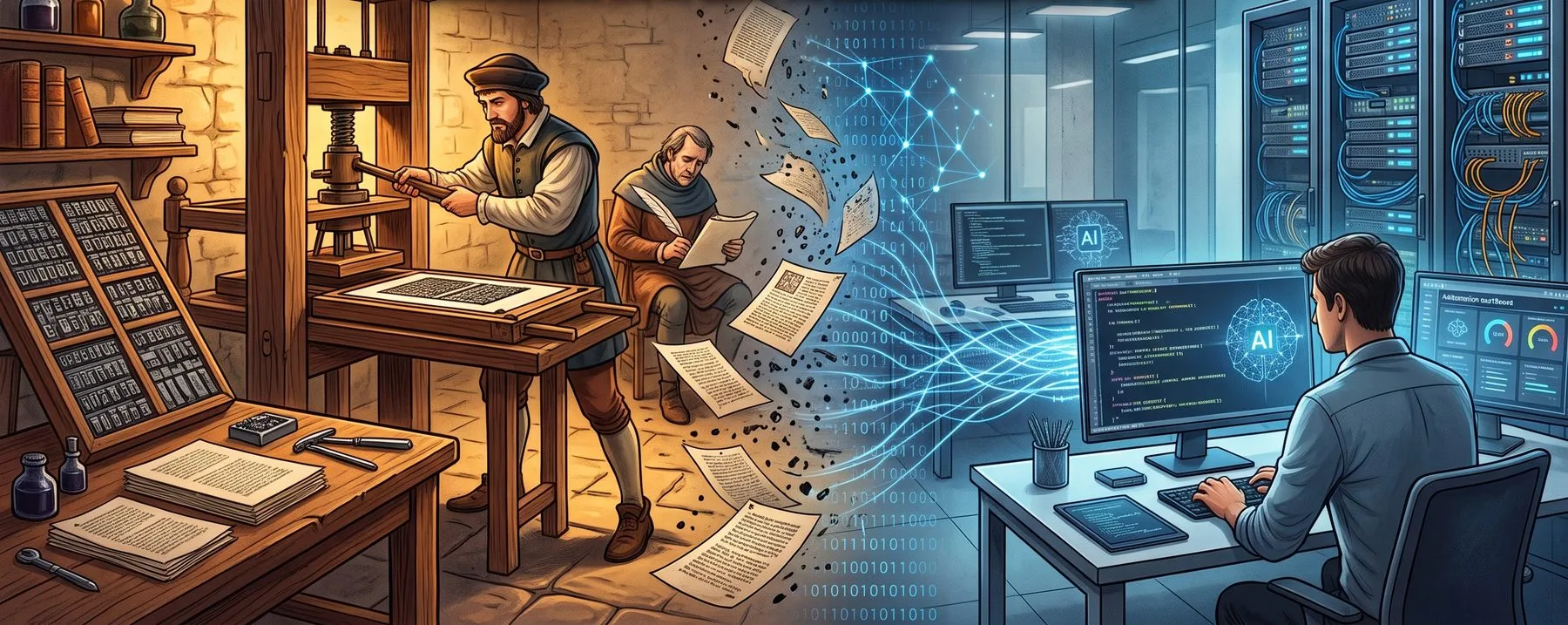
The spread of artificial intelligence (AI) agents and their easy accessibility have created a justified “Am I going to lose my job?” anxiety in many professions, computer and software engineers first among them. This concern is not unfounded; technology giants such as Amazon, Microsoft and IBM have carried out layoffs partly under the influence of this transformation. But looking at the other side of the coin, AI tools have opened the way to the largest increase in production and productivity of recent years. Their capabilities are still subject to certain limits, yet these tools now serve as a unique bridge for people to realise the ideas in their minds.
The Real Value Among the Junk
Undoubtedly, a large share of this rapidly produced content can be described as “junk”. We come across such content frequently on social media platforms in particular, produced merely to attract attention or to earn revenue per view.
But the heart of the matter lies in the opportunities offered to qualified people who are specialists in their fields, who have excellent ideas in their minds, but who lack the software or hardware knowledge to turn those ideas into a product. Even with zero coding knowledge, a competent film director, an experienced researcher, or a professional specialised in a specific field can now turn a project in their head into a concrete product very quickly.
Imagine: you have been editing film for years and you want to add new capabilities to the programs you use, but since you cannot code, everything stays at the level of an idea. Today, however, a few weeks of concentrated work is enough to develop a tool tailored to your own needs. Similarly, a finance specialist who could not code had to analyse the data they needed to track while drowning in complicated Excel spreadsheets; now, with a little effort, they can easily visualise that data and run whatever statistical calculations they want within seconds.
My Own Experience: Automation in the Laboratory
As for my own case: this process made the quality management and accreditation responsibilities I carry out in the laboratory far easier and more traceable. Although my coding skills are at a basic level, I kept postponing the idea of building from scratch the comprehensive automation system I had been thinking about for years. The quality management side was only one part of my actual job, and coding such an infrastructure by traditional means demanded an enormous amount of time. Now, with the help of AI-assisted coding assistants such as Claude Code, I completed a large portion of this automation system in as little as one month, and I use it actively.
A New Age of Enlightenment
These examples could be multiplied. The point I want to stress is this: AI tools have radically increased production and productivity, and will continue to do so.
Looking back at history, when the printing press was first invented some calligraphers no doubt lost their work; yet the countless printed books made knowledge accessible to all of humanity and created an enlightenment.
We are still at the dawn of the AI age. As the capabilities of these tools develop, humanity may record its fastest and most comprehensive advance since the invention of the printing press.